EMI Filters for MRI Suites, Intraoperative MRI, and Magnetic Resonance Imaging Rooms
MRI suites and intraoperative MRI (iMRI) rooms require interference-free Ethernet and PoE connections that do not compromise the RF shield’s performance at the magnet’s Larmor frequencies. DJM ACTIV filters use digital signal processing (DSP) to deliver 100dB shielding effectiveness from 10kHz to 40GHz, with active electronics specifically designed to be quiet in the bands MRI imaging requires. They are the only filters that physically work for MRI Ethernet. Made in the USA.
Why MRI Suites Need Active DSP-Based Filtering
An Ethernet filter for an MRI suite must pass the data signal through frequencies that span DC to roughly 500MHz. Modern clinical MRI systems operate at Larmor frequencies that fall directly inside this passband: 64MHz for 1.5T systems, 128MHz for 3T systems, 298MHz for 7T research systems. The filter must pass these frequencies for the Ethernet data to function, while simultaneously preventing the RF shield from leaking at the same frequencies.
This is why there are no passive Ethernet filters on the market that work for MRI. The physics is unambiguous: a passive filter that blocks the Larmor frequencies also blocks the Ethernet data. Vendors who claim a passive Ethernet filter works for MRI are making a claim the physics does not support. Active DSP-based filtering reads the Ethernet signal, removes the EMI, and reconstructs it on the clean side. It is the only approach that physically resolves this conflict.
Anything with electricity running through it is a potential transmitter inside the MRI room. DJM ACTIV filters do contain active electronics, and yes, they radiate at low levels. The difference is that DJM’s design is specifically engineered to be quiet at the frequencies MRI imaging requires. The active electronics are tuned for the Larmor band. Compared to fiber media converters, which radiate broadband noise across the enclosure interior at frequencies the imaging system actively measures, DJM filters are an order of magnitude quieter where it matters.
Five Reasons to Choose DJM EMI Filters
- Engineered for the Larmor band. The ACTIV 10G delivers 100dB shielding effectiveness from 10kHz to 40GHz. That includes the Larmor frequencies of every clinical MRI system in use today: 64MHz for 1.5T, 128MHz for 3T, 298MHz for 7T. The DSP signal reconstruction is specifically tuned to be quiet in the bands MRI imaging measures, while passing Ethernet data at full line rate.
- Quiet where it matters. Anything with electricity in an MRI room is a potential transmitter. ACTIV filters do contain active electronics inside the shielded space, and the filter itself is not an exception to that rule. The difference is in the design: emissions are suppressed in the bands MRI imaging actually uses. Fiber media converters cannot make the same claim, because they generate broadband noise across the same frequencies your magnet is measuring.
- RJ-45 to RJ-45 with no protocol conversion. Service consoles, gradient amplifiers, patient monitoring systems, surgical navigation platforms, and intraoperative MRI tooling all use Ethernet. Standard CAT cable runs from the equipment side directly through the filter into the RF shielded enclosure. No SFPs, no fiber jumpers, no conversion electronics inside the suite.
- Drop-in retrofit ready. The Universal Mounting System fits most existing MRI suite filter penetrations with little or no wall modifications. Standard penetration lengths handle wall thicknesses from 1/8″ to over 11″. Custom lengths available for layered shield walls and unusual constructions.
- Made in the USA. Every DJM filter is built in the United States and ships fully tested. We are the manufacturer, not a distributor. TAA compliant, Section 889 clean. Documentation available for hospital and research facility procurement.
Performance Data
| ACTIV 10G | ACTIV POE | |
|---|---|---|
| Filter Type | Active, DSP signal reconstruction | Active, with integrated PoE injection |
| Protocol / Signal | Ethernet 10Mbps to 10Gbps (10BASE-T, 100BASE-TX, 1000BASE-T, 10GBASE-T) | Ethernet 10Mbps to 10Gbps with PoE (IEEE 802.3bt Type 3, up to 60W) |
| Frequency Range | 100kHz to 40GHz | 100kHz to 40GHz |
| MRI Larmor Coverage | 64MHz (1.5T), 128MHz (3T), 298MHz (7T) | 64MHz (1.5T), 128MHz (3T), 298MHz (7T) |
| Shielding Effectiveness | >100dB from 10kHz to 40GHz (typical) | >100dB from 10kHz to 40GHz (typical) |
| “Installed SE” | >100dB from 100kHz to 40GHz (cable-independent) | >100dB from 100kHz to 40GHz (with S/FTP CAT6 or CAT6A) |
| Insertion Loss | >100dB from 10kHz to 40GHz (typical) | >100dB from 250kHz to 40GHz (typical) |
| Self-Emissions | Minimal (tuned quiet at MRI Larmor frequencies) | Minimal (tuned quiet at MRI Larmor frequencies) |
| Power Required | Yes | Yes |
| Connectors | RJ-45 in / RJ-45 out | RJ-45 in / RJ-45 out |
Our MRI Suite Filter Lineup
Two DJM filters address the active signal-line requirements of MRI suites, intraoperative MRI rooms, and MR-equipped surgical theatres. Contact engineering for application-specific configurations. We work with MRI room designers, integrators, and shielding manufacturers on customized solutions for new builds and retrofits.
Powered Devices Inside the MRI Suite
Modern MRI suites need more than just a network connection through the shield wall. Patient monitoring cameras, nurse call stations, environmental sensors, communication panels, and patient comfort systems all require power and network connectivity inside the magnet room. DJM filters make this possible.
Externally Powered Ethernet Devices
For Ethernet devices powered by their own AC supply (in-room workstations, dedicated controllers, larger sensors), use the ACTIV 10G to filter the data path. Building power reaches the device through a separate filtered AC penetration. Two penetrations, one for data, one for power, both in the shield wall.
PoE-Powered Ethernet Devices
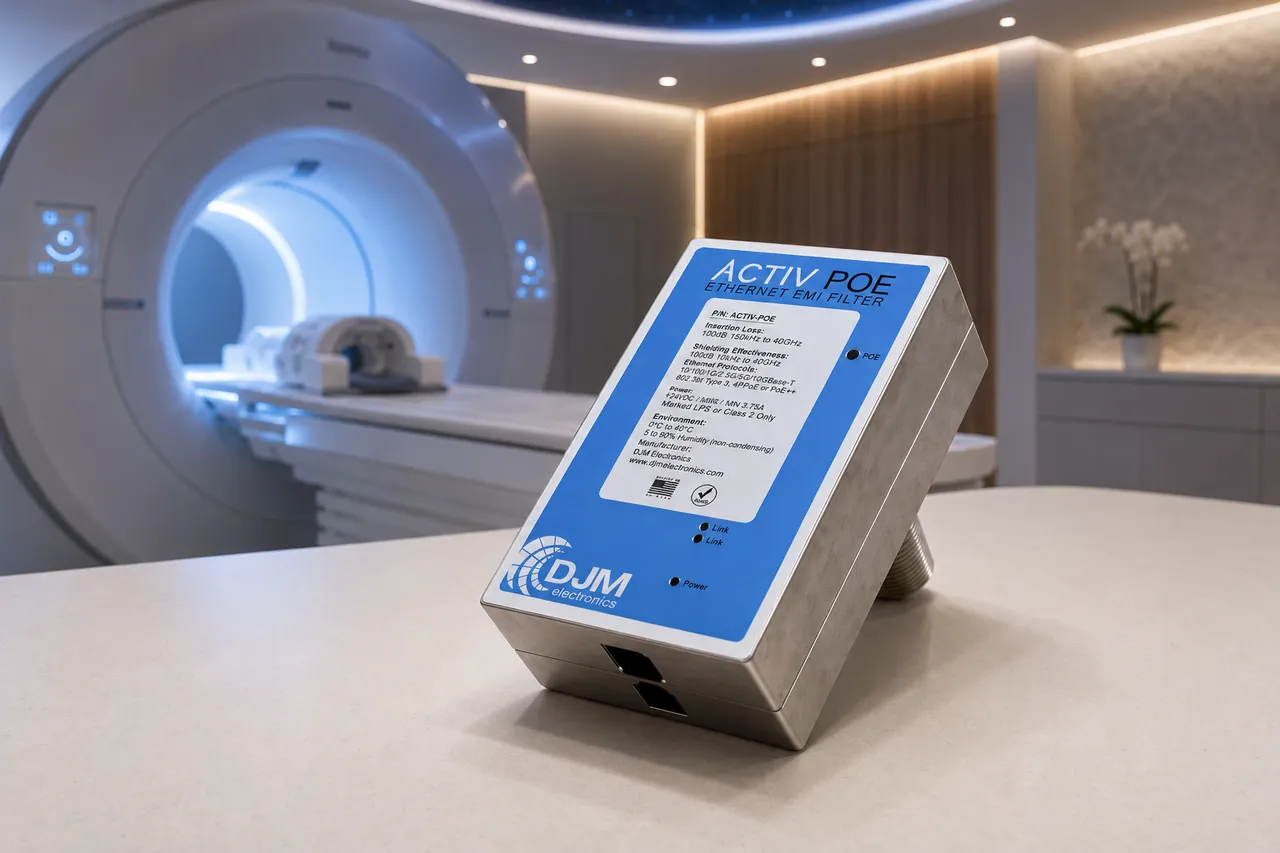
For PoE-powered devices (cameras, nurse call stations, environmental monitors, lighting, communication panels), the ACTIV POE generates Power over Ethernet at the enclosure boundary and filters both the data and the PoE simultaneously. The data path and the device power both originate at the filter and travel into the suite on a single CAT cable. One filter, one device, one penetration.
Contact engineering with your in-room device list and we will spec the right combination of filters for your installation.
Drop-In Installation for MRI Suites
Every DJM filter installs through a single hole in the shield wall using the Universal Mounting System. The threaded hub on the filter body mates to an interchangeable threaded penetration pipe in standard lengths of 1″, 3″, 9″, and 12″, accommodating shield wall thicknesses from 1/8″ to over 11″.
- One hole, one filter. Drill a 1 3⁄8″ circular hole, insert the filter, tighten the flange nut on the enclosure-interior side. No filter or connector plate necessary, no intermediate hardware. The wall is the filter-mount.
- Universal Mounting System fits any RF shield wall. Standard penetration pipe lengths handle the vast majority of MRI suite enclosure constructions, including layered shield walls, RF copper, RF galvanized, and modular shielded panels. Custom lengths available for any wall thickness.
- Swap the pipe, not the filter. MRI suite wall thicker than you thought? Loosen the penetration pipe with a wrench, thread on a different length, reinstall. The filter body, flange nut, gasket, and mounting hole are reused.
- Built for retrofit. The Universal Mounting System fits most existing MRI suite filter penetrations with minor wall modification. For older suites with non-standard penetrations, custom mounting is available. Most MRI suite retrofits do not require new enclosure construction.
Frequently Asked Questions
Relevant Articles and Documents
Universal Mounting System
Field-replaceable penetration lengths for ACTIV and Pasif filters. Change the wall thickness in three minutes instead of three months.
Read Application Note →Cables, Connectors and Protocols... Oh My!
Why “I need an RJ45 filter” isn’t enough information to pick the right filter
Read Article →The Fiber Fallacy
Why the Fiber Default isn't always the best solution.
Read Article →MRI Standards and References
Overview: The International Medical Device EMC Standard — IEC 60601-1-2 (Interference Technology)
Methodology explainer: IEEE 299 and 299.1 on Measuring the Shielding Effectiveness of Enclosures (EMC United)
(current as of May 31, 2026)
Methodology explainer: Improving the Way We Measure Insertion Loss (Interference Technology)
Overview: Promoting Safe Use of MRI Technology (ASTM)
We Want to Help You Specify the Right Filter
MRI suite filter requirements vary widely depending on field strength, suite layout, in-room device list, and shielding manufacturer. Our engineering team works with MRI room designers, integrators, and shielding manufacturers on customized solutions for new builds and retrofits. Tell us about your application and we will help you spec the right filter combination.