Ethernet and Digital Signal EMI Filters for
EMC/RF Test Enclosures and
Anechoic Chambers
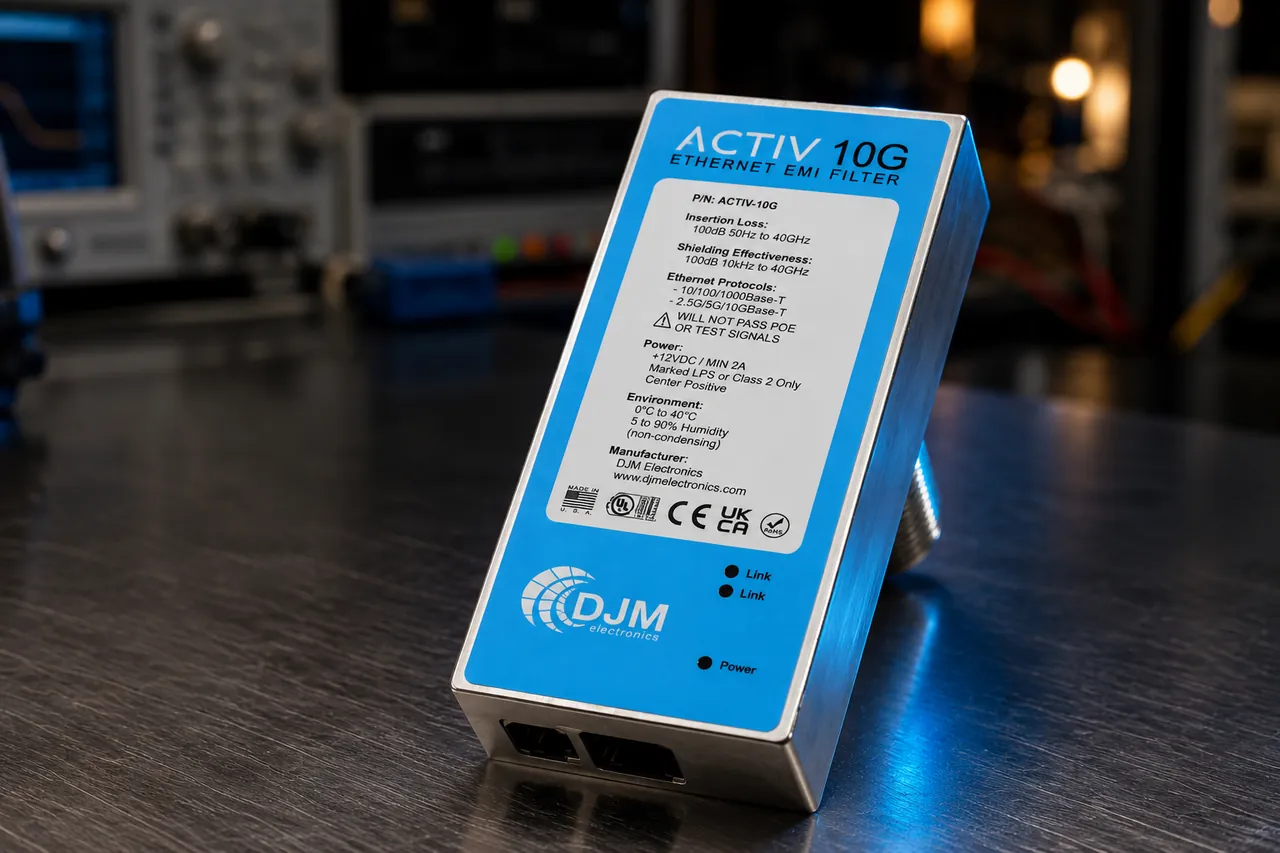
EMC test chambers and shielded enclosures demand signal lines that do not contaminate the chamber's or enclosure's noise floor. DJM ACTIV and Pasif EMI filters deliver quantified shielding performance and insertion loss from 10kHz to 40GHz on standard CAT and USB-C cabling, with little to no self-generated emissions inside the chamber. Insertion loss measured per MIL-STD-220B. Shielding effectiveness referenced to IEEE 299. Drop-in retrofit ready for existing chambers. >100dB across the frequency range. RJ-45 and USB-C connections. Up to 10Gbps full throughput. Made in the USA.
Six Reasons to Choose DJM EMI Filters
- Proven >100dB shielding performance and insertion loss. DJM ACTIV filters use digital signal processing (DSP) to reconstruct Ethernet and USB signals on the clean side of the filter, delivering >100dB shielding effectiveness from 10kHz to 40GHz with no signal degradation and no unwanted artifacts. Insertion loss is measured per MIL-STD-220B. Shielding effectiveness is referenced to IEEE 299.
- Future-proof to 40GHz. 5G mmWave testing reaches 39GHz. Automotive radar runs 24GHz and 76 to 81GHz. Many chamber filters in the field today cut off at 18GHz or 26GHz. Media converters need waveguides that start to fail and leak at even lower frequencies. The ACTIV 10G is rated and characterized up to 40GHz with no waveguide required.
- Honest “Installed Shielding Effectiveness”. Shielding effectiveness (SE) is typically measured without cables, the best-case number for an empty, sealed enclosure. The moment cables are attached to typical filters, SE performance plummets. For ACTIV filters, DSP removes EMI regardless of cable type so the real-world “Installed Shielding Effectiveness” tracks advertised filter SE. For the Pasif 1G, we publish the installed SE math using S/FTP CAT6A and tell you the number you should expect to see. Compare that to competitive filters.
- Lowest possible emissions inside the chamber or enclosure. Every DJM filter is designed with all active electronics outside the shielded space. The Pasif 1G has no unintentional radiators at all. The ACTIV filters leave only the signal reconstruction output inside, with no power supply and no fiber transceiver radiating into your measurement environment. Compared to any other solution, DJM filters have the least emissions and are unequivocably the quietest solution.
- Drop-in retrofit ready. The Universal Mounting System (UMS) fits most existing chamber filter penetrations with little or no wall modifications. Standard penetration lengths handle wall thicknesses from 1/8″ to over 11″. Custom lengths available for any chamber wall configuration.
- Made in the USA. Every DJM filter is built in the United States and ships fully tested. We are the manufacturer, not a distributor. TAA compliant, Section 889 clean. Documentation available for federal procurement and accredited test laboratories.
Performance Data
| ACTIV 10G | ACTIV POE | ACTIV USB 3.1 | Pasif 1G | |
|---|---|---|---|---|
| Filter Type | Active, DSP signal reconstruction | Active, with integrated PoE injection | Active, DSP signal reconstruction | Passive, cascading LC stages |
| Protocol / Signal | Ethernet 10Mbps to 10Gbps (10BASE-T, 100BASE-TX, 1000BASE-T, 10GBASE-T) | Ethernet 10Mbps to 10Gbps with PoE (IEEE 802.3bt Type 3, up to 60W) | USB 1.1, USB 2.0USB 3.1 Gen 2 (SuperSpeed+ to 10Gbps)(Power Delivery up to 60W: 15W, 27W, 45W, 60W profiles) | Ethernet up to 1GbpsPoE pass-throughNon-Ethernet signals on CAT cable |
| Frequency Range | 10kHz to 40GHz | 10kHz to 40GHz | 10kHz to 40GHz | 1MHz to 40GHz |
| Shielding Effectiveness | >100dB from 10kHz to 40GHz (typical) | >100dB from 10kHz to 40GHz (typical) | >100dB from 10kHz to 40GHz (typical) | >100dB from 10kHz to 10GHz (typical, tested without cables)>85dB from 10GHz to 40GHz (typical, tested without cables) |
| “Installed SE” | >100dB from 10kHz to 40GHz (cable-independent) | >100dB from 10kHz to 40GHz (cable-independent) | >100dB from 10kHz to 40GHz (cable-independent) | >80dB from 1MHz to 40GHz (with S/FTP CAT6A) |
| Insertion Loss | >100dB from 10kHz to 40GHz (typical) | >100dB from 250kHz to 40GHz (typical) | >90dB from 1kHz to 40GHz (typical) | >90dB from 700MHz to 30GHz (typical)>80dB from 550MHz to 40GHz (typical) |
| Self-Emissions | Minimal | Minimal | Minimal | None |
| Power Required | Yes | Yes | Yes | No |
| Connectors | RJ-45 in / RJ-45 out | RJ-45 in / RJ-45 out | USB-C in / USB-C out | RJ-45 in / RJ-45 out(8 lines, 4 pairs or 8 single-ended) |
Our EMC/RF Testing Filter Lineup
Four DJM filters cover the vast majority of EMC test chamber Ethernet and USB-C signal-line requirements. All four are stocked and ship from San Diego. For specialized configurations including hardwired variants, HDMI filtering, EMP-hardened installations, USB 2.0 and AC power filtering, we also build special-order configurations. Contact engineering for custom specifications.
Real Shielding Performance
“Shielding Effectiveness (SE)” in simple terms is a measure of a shield’s effectiveness at blocking radiated signals. It is measured on a shielded enclosure or room with all penetrations sealed and no cables attached. An antenna transmits outside, another receives inside. The ratio of transmitted level to received level is the SE. This is what chamber manufacturers publish and what IEEE 299 measures. It is the best-case number, describing the shielding performance of the room alone, not the room you will actually be using.
“Insertion Loss (IL)” (sometimes called “rejection”) is a measure of a filter’s effectiveness at blocking signals conducted on the filtered lines. It is measured on a filter in isolation. A signal goes in one end and the filter blocks all or most of it depending on its design. What comes out is compared to what went in and the ratio is the Insertion Loss. Measured per MIL-STD-220B with 50-ohm terminations. DJM publishes this specification for every filter, but it can be deceiving unless you know what you are looking at.
“Installed SE” is an estimate of the shielding effectiveness you actually get in practice. Sometimes it is the same as SE, but when SE and IL have different attenuations at different frequencies it is more complicated. Since cables and wires can act as antennas, signals can “couple” onto the wire and be transmitted through the filter and re-radiated on the other side. The frequencies and levels of transmission depend on the level of emissions that couple onto the cable, the IL of the filter, and the level of emissions that are transmitted on the other side. A shielded wire or cable can reduce the coupling, but may not eliminate it. Installed SE combines the filter SE, the filter IL, the cable shielding along the internal and external run, and all the accumulated losses to estimate the “real world SE.”
For ACTIV filters: the DSP reconstructs the signal without EMI on the clean side. Cable shielding has little to no effect on “Installed SE” because the filter, not the cable, does all the attenuation. “Installed SE” for ACTIV filters tracks filter SE across all cable types. The numbers in the Performance Data table above are cable-independent.
For the Pasif 1G: filter IL is near zero below 550MHz because the filter must pass Ethernet signals through that band without attenuation. Below 550MHz, “Installed SE” is delivered by the cable shielding, working through two mechanisms operating in series. The external cable shield reduces coupling of environmental EMI onto the cable conductors. The internal cable shield reduces re-radiation of any signal that does ride on the conductors past the filter. With S/FTP CAT6A on both sides and properly bonded 360-degree shield terminations, the two mechanisms together deliver an “Installed SE” floor of 80dB from 1MHz upward. At 550MHz, filter IL hits the rated 80dB and takes over from cable shielding as the dominant mechanism. From 700MHz to 30GHz, filter IL exceeds 90dB. With unshielded cable below 550MHz, filter IL alone cannot make up the difference, and “Installed SE” in that frequency range depends entirely on whatever cable shielding the installation provides.
A fuller analysis with worked examples across the frequency band is in development. See the Coming Soon tile in the Relevant Articles and Documents section below.
Drop-In Installation for Existing and New Chambers
Every DJM filter installs through a single hole in the chamber wall using the Universal Mounting System. The threaded hub on the filter body mates to an interchangeable threaded penetration pipe in standard lengths of 1″, 3″, 9″ and 12″, accommodating chamber wall thicknesses from 1/8″ to over 11″. Custom penetration lengths handle unusual chamber configurations. Aluminum with electroless-nickel plating throughout.
- One hole, one filter. Drill a 1-3/8″ circular hole, insert the filter, tighten the flange nut on the chamber-interior side. No filter or connector plate necessary, no intermediate hardware. The wall is the filter-mount.
- Swap the pipe, not the filter. Enclosure or chamber wall thicker than you thought? Loosen the penetration pipe with a wrench, thread on a different length, reinstall. The filter body, flange nut, gasket, and mounting hole are reused.
- Includes a 1-foot CAT 6 extension for every Ethernet filter. An unshielded RJ-45 male-to-female extension (black, 1 foot) ships with every DJM Ethernet filter. The extension is optional but useful when enclosure-side cables are connected and disconnected frequently. For permanent installations where the user cable runs straight to the filter, the extension is not required and is typically omitted. A shielded version (red, 1 foot) is available on request for installations where chamber-side cabling is shielded throughout.
Frequently Asked Questions
For the Pasif 1G, cable choice meaningfully affects “Installed SE” below 550MHz. Standard S/FTP CAT6A is the reference assumption behind our published 80dB “Installed SE” floor. With unshielded cable, “Installed SE” degrades sharply below 550MHz where filter IL has not yet climbed.
There is one combination to avoid: a shielded cable or extension connected to an unshielded cable or extension. The discontinuity at the connection point effectively becomes an antenna, radiating any signals that would normally be confined inside the shielded cable. The rule is straightforward. Shielded cable must connect to a shielded extension or directly to the filter. Unshielded cable must connect to an unshielded extension or directly to the filter. Mixing shielded and unshielded across a connection point turns the shielded portion into a radiator.
The Pasif 1G can pass any signal that fits within its specifications. With a DJM RJ-45 to terminal block adapter, the same 8-line architecture filters fire alarm, HVAC controls, RS-232 / RS-422 / RS-485 serial, dry contact sensing, low-voltage DC power, and similar low-current signals up to 500mA per line at 57VDC or 40VAC. Contact engineering with your signal details and we will confirm fit.
Relevant Articles and Documents
Universal Mounting System
Field-replaceable penetration lengths for ACTIV and Pasif filters. Change the wall thickness in three minutes instead of three months.
Read Application Note →Cables, Connectors and Protocols...
Oh My!
Why “I need an RJ45 filter” isn’t enough information to pick the right filter
Read Article →The Fiber Fallacy
Why the Fiber Default isn't always the best solution.
Read Article →EMC Relevant Standards and References
Overview: CISPR 11 scope, equipment classifications, and test requirements (Keystone Compliance)
Overview: CISPR 32: What Is It, Why Was It Written and Where Is It Going? (Interference Technology)
Overview: ANSI C63.4 scope, instrumentation requirements, and role in FCC compliance (Keystone Compliance)
(NASA SSRI Knowledge Base hosting; current as of May 31, 2026)
(current as of May 31, 2026)
Methodology explainer: Improving the Way We Measure Insertion Loss (Interference Technology)
Methodology explainer: IEEE 299 and 299.1 on Measuring the Shielding Effectiveness of Enclosures (EMC United)
Overview: EMC Immunity Testing: Do You Know Your Failures? — covers IEC 61000-4-2 (ESD), 4-3 (radiated), 4-5 (surge), 4-6 (conducted RF) (Interference Technology)
Ready to Specify Your EMC Chamber Filter?
Talk to our engineering team about ACTIV 10G, ACTIV POE, ACTIV USB 3.1 or Pasif 1G for your EMC chamber, anechoic chamber or shielded enclosure. Hardwired variants, HDMI, EMP-hardened filters, Pasif USB 2.0 and AC power filtering are available as special-order configurations.