EMI Filters for High-End Audio
and Streaming Systems
Reference listening environments require reference noise floors. Network noise on Ethernet conducted to your DAC, streamer, or music server can reach the analog signal chains of your system and degrade resolution and dynamic range. DJM filters use active Digital Signal Processing (DSP) signal reconstruction to create bit perfect copies of your music to remove this interference completely. Our filters provide 100dB of noise rejection from 50Hz to 40GHz on the CAT cable you already have. That is 99.99999999% of the electrical noise removed. Measurable performance, characterized per MIL-STD-220B. Made in the USA.
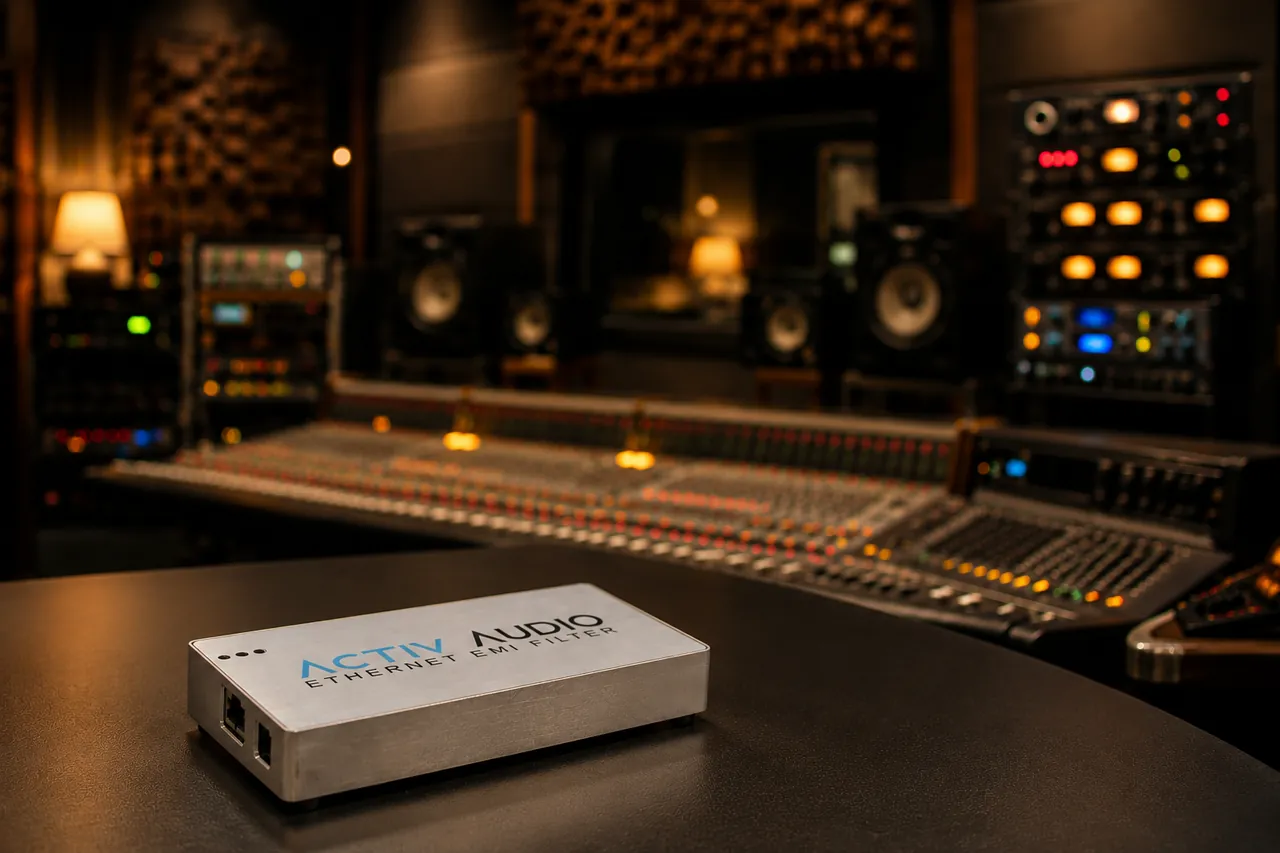
Five Reasons to Choose DJM EMI Filters
- The deepest noise rejection in the market. The ACTIV 10G delivers greater than 100dB noise rejection across the audio-relevant band. Hybrid active and passive filtering, DSP signal reconstruction, stripline routing and shielded PCB construction all work together. No passive LC filter at any price hits this depth.
- Better than fiber. Fiber media converters provide galvanic isolation, but they generate broadband EMI from the fiber transceiver electronics back onto the Ethernet conductors. The ACTIV 10G provides equivalent galvanic isolation through DSP signal reconstruction without the EMI generation, dual power supplies, special fiber cables, or the general visual mess. Use standard CAT cable up to the filter. Use audiophile-grade cable from the filter to your DAC where it matters most.
- Bit-perfect data, no audio modification. The ACTIV 10G reads each Ethernet packet, removes EMI from the conductors and passes bit-perfect copies of your streaming audio data to the clean side. The audio bits arriving at your DAC are identical to what left your streamer or server. The filter cleans the electrical noise, not the audio data.
- The ACTIV 10G appears to your network as a standard Ethernet link. Plug it in. Connect your CAT cables. Done. No special drivers, no configuration, no protocol surprises. Auto-negotiates from 10Mbps to 10Gbps.
- Made in the USA, individually tuned and tested. Every DJM filter is built in the United States and individually tuned and tested before shipping. We don't ship batch-tested or sample-tested filters. Each unit is verified to meet specification.
Performance Data
Specifications for DJM filters recommended for audiophile and high-end audio installations. The ACTIV 10G and Pasif 1G are stocked products. The Pasif USB 2.0 is also available.
| ACTIV 10G | Pasif 1G | Pasif USB 2.0 Out of Stock |
|
|---|---|---|---|
| Filter Type | Active, hybrid active and passive filtering with DSP signal reconstruction | Passive, multi-stage LC network | Passive, multi-stage LC network |
| Protocol / Signal | Ethernet 10Mbps to 10Gbps | Ethernet up to 1Gbps | USB 1.1, USB 2.0 (Low / Full / High Speed) |
| Frequency Range | 50Hz to 40GHz | Above the Ethernet band, through 40GHz | Above the USB 2.0 band, through 40GHz |
| Insertion Loss (Noise Rejection) | >100dB from 50Hz to 40GHz | >80dB above the Ethernet band,climbing to >90dB across most of the band | >80dB above the USB 2.0 band,climbing to >90dB across most of the band |
| Self-Emissions | Minimal | None | None |
| Power Required | Yes | No | No |
| Connectors | RJ-45 (×2) | RJ-45 (×2) | USB 2.0 Type B in /USB 2.0 Type A out |
What Real EMI Filter Engineering Looks Like
The ACTIV 10G isn't a passive LC filter in a fancy expensive enclosure. It's a multi-disciplinary engineering project that draws on PCB design, RF engineering, mechanical engineering, digital signal processing and power supply design. Audiophile boutique brands compete on cosmetics. We compete on what's actually inside the housing. Here's what's there.
- A precision-machined aluminum housing. The body is solid stock, machined to fit the electronics inside. Multiple screws secure each cover. The result is a rigid, low-noise enclosure that performs as part of the filter, not just a container for it.
- Physical separation between input and output. The input and output stages of the filter are physically isolated from each other inside the housing. Noise that enters one side cannot find a path through the filter electronics to the other side.
- Multi-layer shielded circuit board construction. The internal PCB design uses multiple ground planes and shielding techniques developed by professional RF filter engineers. Standard audiophile and consumer-grade filter manufacturers use simpler, lower-cost board designs that don't isolate signals as effectively.
- Internal shielding between filter stages. Vertical and horizontal shielding inside the circuit board itself prevents noise from propagating through the filter. Most filter designs allow noise to bleed between stages. We don't.
- Fully balanced, fully differential signal paths. Every high-speed signal in the filter is a balanced pair. Noise that affects both halves of the pair cancels itself out, before it ever reaches the digital signal processor.
- Multi-stage internal power supply filtering. The filter's own power supply is filtered in multiple stages so the supply itself never becomes a noise source. Many consumer-grade filter designs ignore this and add their own power supply noise to the signal path.
The result is hybrid active and passive filtering that delivers greater than 100dB rejection for everything except the data signal you want to pass. This is what real EMI filter engineering looks like. The Pasif 1G is engineered with the same rigor in a passive multi-stage LC architecture. The boutique audiophile market builds nothing close to this (or they would provide the performance specs).
Engineering vs Marketing
DJM ACTIV 10G vs Fiber Media Converters
Audiophiles often gravitate toward fiber media converters because of the galvanic isolation they provide. The reasoning is sound. The implementation is a mess.
A fiber media converter setup requires two converters (one on each side of the network break), a fiber patch cable between them, two AC power supplies, two AC outlets, mounting hardware on both sides and special fiber-to-RJ45 conversion electronics that themselves generate broadband EMI. The EMI from the converter chips radiates back onto the network conductors, partly defeating the isolation the fiber was supposed to provide.
The ACTIV 10G provides galvanic-equivalent isolation through DSP signal reconstruction in a single device with one CAT cable in, one CAT cable out, one power feed. No converter EMI. No cable swaps. No mounting hardware on both sides. Better than fiber. Cleaner than fiber. Simpler than fiber.
DJM Filters vs Audiophile Boutique Passive Filters
Most audiophile Ethernet filters fall into one of three categories: simple ferrite chokes in fancy enclosures, basic one to three stage passive LC networks, or galvanic isolation transformers marketed as filtering. None of these match the engineering depth of even the Pasif 1G, never mind the ACTIV 10G.
Most audiophile filter brands don't publish full frequency-domain measurements. The ones that do typically show peak attenuation in a narrow band rather than broadband performance. Most don't disclose stage count. Most don't disclose what's actually inside the housing, because what's inside is the cheap part and the expensive part is the housing. Premium aluminum, copper plating, exotic woods and isolation feet drive the bill of materials. The actual filter components are commodity.
The DJM Pasif 1G is a multi-stage cascading LC network designed by EMI engineers who specify filters for SCIF, TEMPEST and EMC test laboratory applications where measurement matters. It outperforms boutique audiophile passives at every stage count and every measurement. Steeper noise rejection above the Ethernet band. Better-published curves. Lower cost per dB.
The ACTIV 10G is structurally different. Hybrid active and passive filtering with stripline PCB construction, via walls, two-board architecture, fully differential signaling and DSP signal reconstruction. No competitor in the audiophile market is doing engineering at this level. The DJM design philosophy is "what does the EMI actually look like, and how do we measure and remove it." The boutique audiophile philosophy is "what does the housing look like."
| Price Tier | Construction | Realistic Peak Rejection | Effective Band |
|---|---|---|---|
| Under $300 | Ferrite chokes or 1 to 2 stage passive LC | 30 to 50 dB | Narrow |
| $300 to $1,500 | 2 to 3 stage passive LC, sometimes with galvanic isolation transformer | 40 to 70 dB | Moderate |
| $1,500 to $5,000 | 3 to 4 stage passive LC, premium components | 60 to 90 dB | Narrow to moderate |
| Over $5,000 | 4+ stage premium passive LC, exotic components, premium enclosures | 70 to 100 dB | Variable, often narrow |
| DJM ACTIV 10G | Hybrid active and passive, DSP signal reconstruction, stripline PCB, two-board architecture | 100 dB measured | 50Hz to 40GHz, full broadband |
The Math of Passive LC Filtering
A multi-stage LC filter's attenuation in the stop band climbs by approximately 6 dB per octave per stage. One stage gives a 6 dB-per-octave slope. Two stages give 12 dB per octave. Three stages give 18. Four stages give 24.
To hit 80 to 100 dB peak attenuation in a passive filter, the design either needs a very high stage count (which introduces in-band signal degradation that audiophiles can hear) or it has to be optimized for a narrow band. This is why most audiophile passive filter brands either don't publish specific dB-vs-frequency curves at all, or publish peak attenuation in a band so narrow that the spec sheet number doesn't reflect real-world performance.
The DJM ACTIV 10G is not bound by these LC physics limits. DSP signal reconstruction reads the data, removes the EMI and rebuilds the signal cleanly, regardless of how many "stages" of EMI removal happen in the math. That's the structural difference.
For the long version, including the four questions to ask any filter maker before you buy, read our article Missing Numbers: Why Smart People Buy Questionable Audio Products.
Our Audiophile Lineup
Three DJM filters serve the high-end audio community. The ACTIV 10G for primary network filtering on streamers, network DACs and music servers. The Pasif 1G for passive Gigabit Ethernet at lower budgets. The Pasif USB 2.0 for USB DAC connections. Contact engineering for custom configurations.
Customers in Europe and the UK
TotalDAC, the French manufacturer of high-end DACs and our exclusive distribution partner in Europe and the UK, integrates the DJM ACTIV 10G as the entry filter in their reference network optimization system. The filter sits between the wall RJ45 jack and the audio system, providing galvanic isolation to the Ethernet signal before it reaches the streamer chain. European audiophile customers purchase DJM filters directly through TotalDAC, with the same factory-fresh product, the same warranty and full access to DJM engineering support. North American customers and customers outside Europe and the UK purchase directly from DJM.
Frequently Asked Questions
Relevant Articles and Documents
Missing Numbers
Why smart people buy questionable audio products, and the four questions to ask any Ethernet filter maker.
Read Article →ACTIV 10G
Data Sheet
Full technical specifications and performance curves.
Download →Pasif 1G
Data Sheet
Full technical specifications and performance curves.
Download →Ready to Hear What Clean Network Looks Like?
Talk to our engineering team about ACTIV 10G or Pasif 1G for your high-end audio installation. Custom configurations available.